
Undersea Transmission Lines: The Future of Global Electricity Networks
How electricity highways on the ocean floor power the grid of today and tomorrow.

Humans are capable of truly awesome engineering feats. From towering skyscrapers to nanometer-scale transistors, we have consistently smashed through physical, chemical, and bureaucratic boundaries in the name of progress. In our pantheon of achievements, however, I believe one particular innovation has flown (or sunk) under the radar: undersea power transmission lines.
First, please enjoy this quick explainer. Let me know in the comments if you too pause the video multiple times and exclaim, “What?! How did they manage that?!”:
Simply brilliant. There are so many reasons not to attempt transmitting massive amounts of electricity underwater, and we did it anyway. Today, roughly 5,000 undersea power lines are in operation, ranging from 40-700km in length. The longest active cable, the Viking Link, is 760km and runs between East England and Denmark. It can carry a staggering 1.4GW of power, enough to run ~2.5 million homes. National Grid, the British utility that runs this project, estimates it will save British households at least £50M annually owing to Denmark’s cheaper (and cleaner) electricity generation.
Why HVDC undersea transmission works
Today, most undersea power cables carry high voltage, direct current (HVDC). Why high voltage? The answer can be found by linking two fundamental electrical principles:
In simple terms, we move electricity across long distances at high voltage to minimise energy loss. For a given amount of power, higher voltage allows for a lower current. Since energy loss due to resistance in the wires is proportional to the square of the current, using high voltage significantly reduces this loss. This is applicable for transmission lines over land and underwater.
But, why use direct current for undersea cables? After all, most overground transmission lines (these giants) use an alternating current (AC), and our modern electrical grid endpoints are AC-compatible. Three key reasons (simplifying here, this page contains in-depth electrical engineering reasons if you’re curious):

DC lines support asynchronous grid connections: This is huge, particularly for cross-border electricity transmission. Each national grid operates at a specific frequency, usually either 50Hz or 60Hz. With AC, it is not possible to directly connect two grids operating at different frequencies. However, DC lines don’t require synchronous grid frequencies, which means they can link asynchronous grids.
DC lines lose less power: In AC wires, the constantly changing direction of electricity creates what are called "capacitive effects", which wastes a lot of energy. This effect is greatly reduced with DC.
DC lines require fewer cabling: AC cables require three current-carrying wires (one for each phase), along with significant protective layering to minimise power leakage between wires and secure supporting equipment. In contrast, DC cables only require 1-2 wires and comparatively less protective layering, which reduces material costs.
Studies show that for undersea distances greater than ~50km, HVDC is far more economical and reliable at transporting electricity than HVAC. While HVDC networks require expensive and complex infrastructure, continuous improvements in network design and power electronics mean that the capital costs will keep decreasing, making HVDC the clear winner for undersea power flow.
The significance of undersea power lines
In my previous blog posts, I have stressed the importance of energy security for nations. Paradoxically, linking national grids is a great way to achieve this. For instance, look at the United Kingdom’s existing undersea power interconnections:
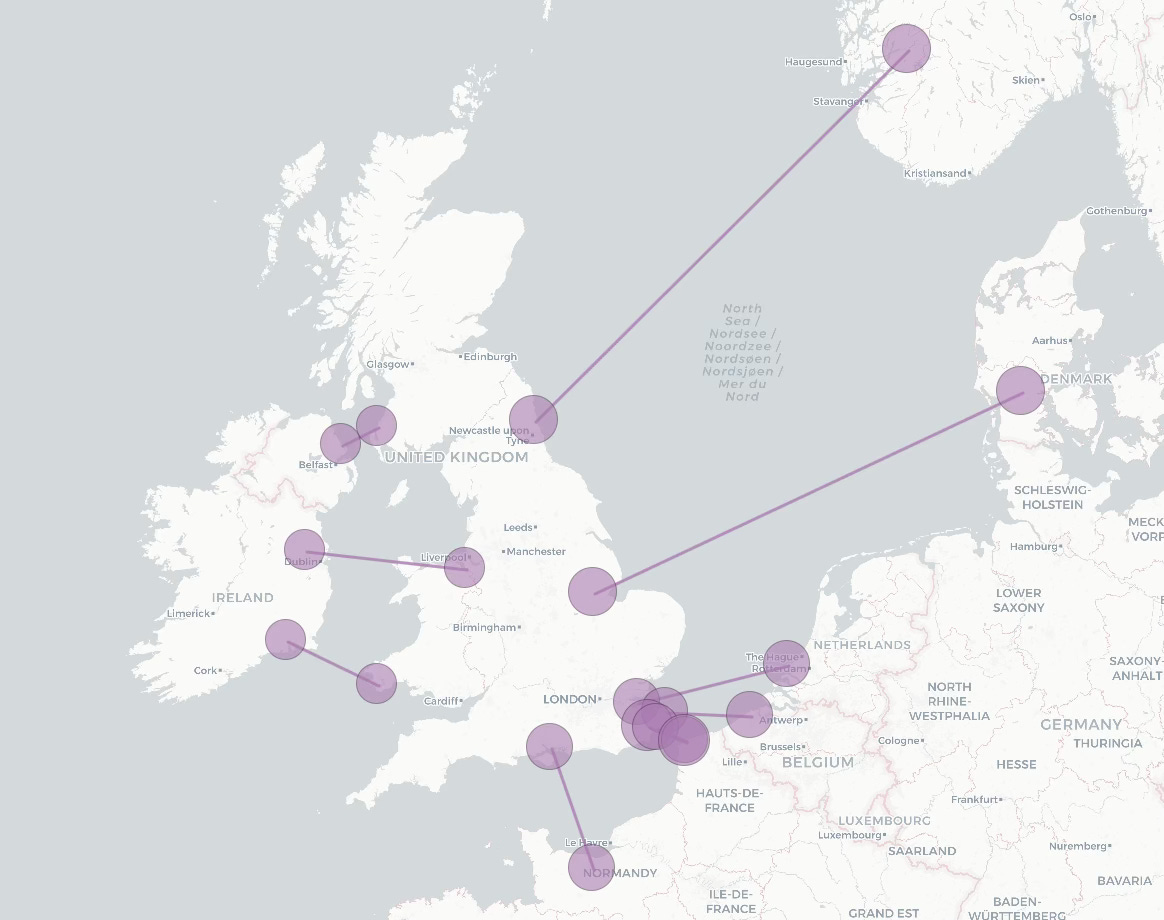
That’s right: the UK’s electrical grid is connected to six European countries. Over the past year, daily National Grid data show that the UK imported an average load of 2.2GW from France, 1.2GW from Norway, and 1GW from Denmark, Belgium, and the Netherlands combined. In 2024, energy imports accounted for 12% of the UK’s energy demand.
Despite Brexit, the UK has actually continued to expand its undersea transmission network. The UK wisely realised that cross-border electricity flow is essential for grid stability, affordable electricity, and supporting renewable energy growth. Also, this is a mutually beneficial relationship as nations like Denmark and France can export surplus electricity generation from their wind/nuclear plants to the UK instead of curtailing production.
Today, the undersea cable manufacturing ecosystem is dominated by European and Japanese companies. Both regions were early to develop offshore wind projects and cross-border electricity transmission owing to geography. Additionally, specialised firms like Italy’s Prysmian Group and Dutch-based Nexans lead the installation process, as these cables require highly customised ships and equipment. A list of operational subsea HVDC transmission projects shows that Europe is by far the global leader in successful projects, powered by a handful of cable manufacturers.
The bright future of undersea transmission
Undersea power transmission has come a long way since 1954, when Sweden launched the world’s first HVDC subsea line linking one of its islands with the mainland. Two planned mega-projects provide a sneak peek into the future of long-distance electricity transmission:
I. Australia-Asia Power Link (AAPL)
This project is bonkers. Before I elaborate, here’s the gist from the project developer:
The project proposes to develop the world’s largest renewable energy generation and battery storage precinct in the heart of the Northern Territory, and a 5,000km HVDC system, to deliver up to 6GW of 24/7 green electricity to industrial customers in Darwin and Singapore.
You read that right. This giant energy generation and interconnection project aims to link northern Australia and Singapore with a 5,000km transmission line, of which 4,300km will be underwater. If/when complete, this line will be 5.5x longer than the Viking Link with a carrying capacity of 2GW. The project was first launched in 2018 but financial and engineering hurdles forced the developer, Sun Cable, to declare bankruptcy in 2023. However, the project was picked up by a consortium of investors who expect the project to begin supplying electricity to Singapore in the early 2030s.
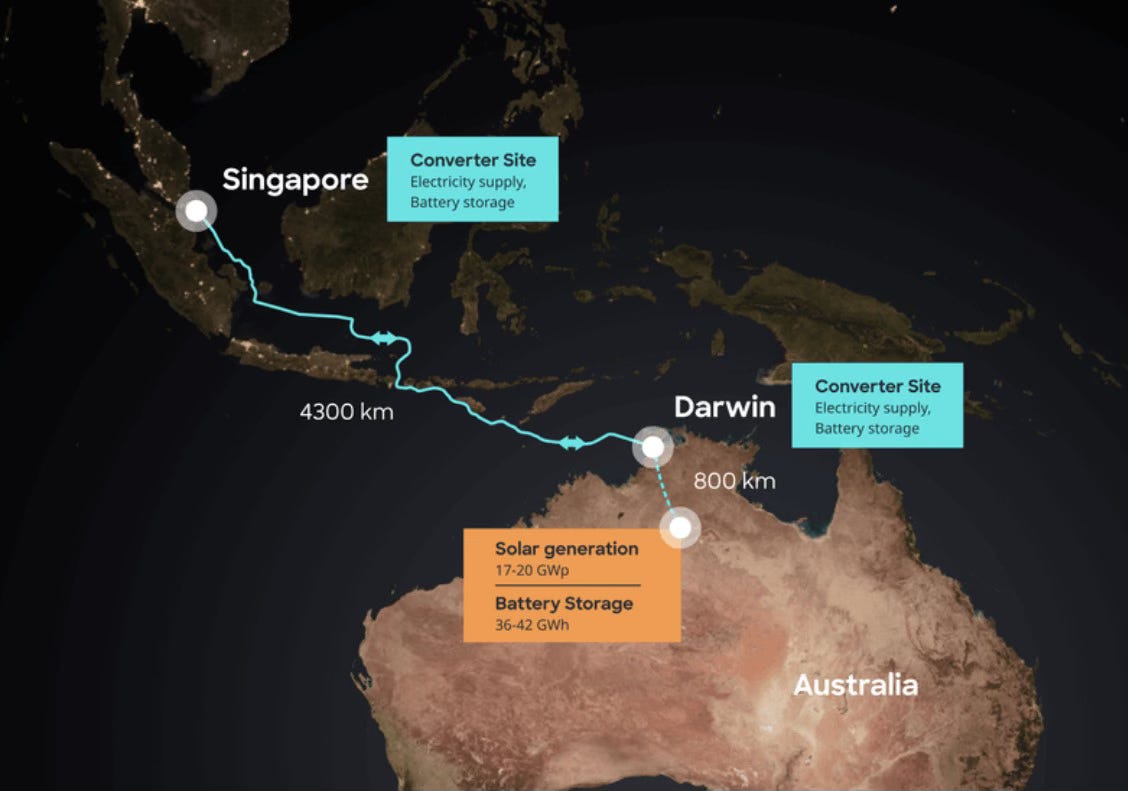
What I find most interesting here is that Sun Cable plans to establish a brand-new HVDC cable manufacturing facility in Tasmania specifically for this project instead of purchasing cables from European/Asian companies. Australia has no major subsea cable equipment makers, making this the first major attempt at HVDC cable manufacturing in the Southern hemisphere as far as I can tell. The engineer in me would love to see this $25B project succeed despite clear technical and regulatory headwinds.
II. Morocco-UK Power Connector
Another intercontinental endeavour, this $30B project aims to generate 11.5GW of renewable energy (solar & wind) in southern Morocco paired with energy storage and transport it to the UK via 4,000km of undersea HVDC cables.
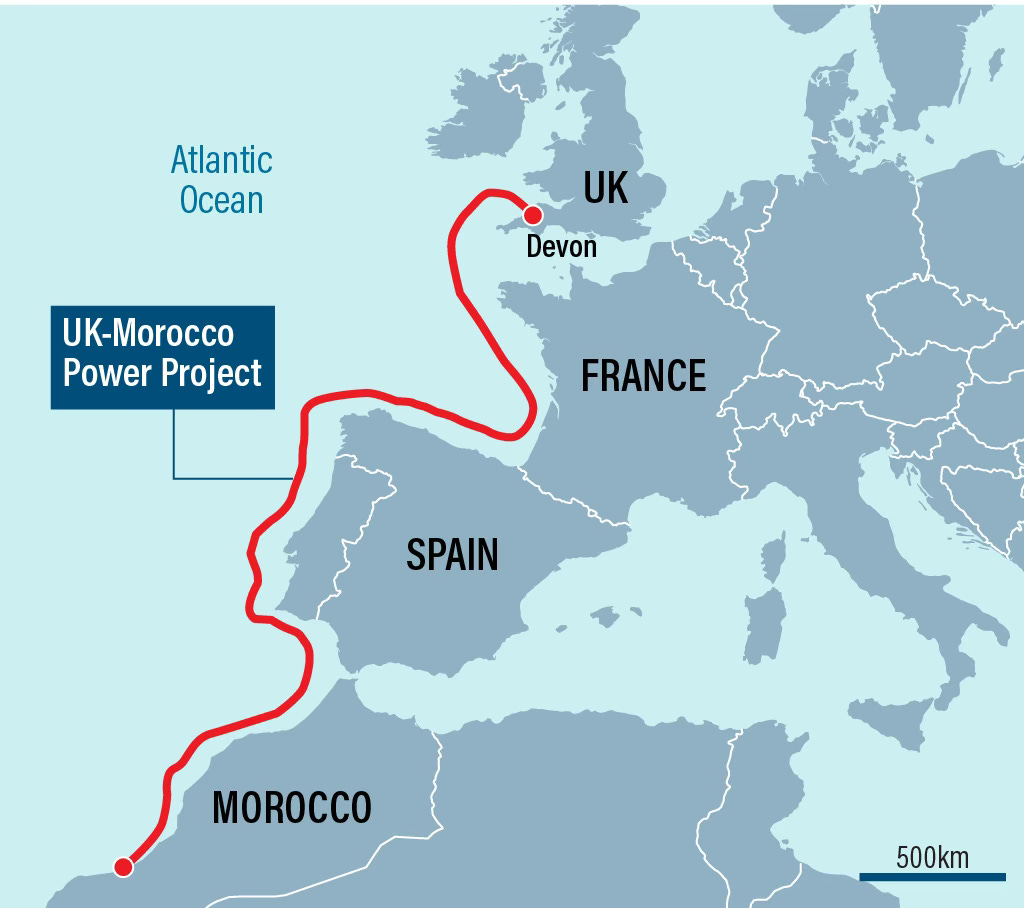
Launched in 2023 by project developer Xlinks, this connector is expected to carry 3.6GW of power to the UK, enough to meet nearly 8% of its entire electricity consumption. Although the undersea cable hugs the coastlines of Portugal, Spain, and France, it will not connect with any of these national grids, which should greatly expedite the permitting process.
The project timeline remains unclear, with Xlinks offering limited transparency around milestones, regulatory approvals, and construction progress. However, this project has attracted several high-profile investors including TotalEnergies, Octopus Energy, and the Abu Dhabi National Energy Company. Also, I am encouraged to see that Xlinks has hired the project leadership team that successfully executed the North Sea Interconnector, a 720km subsea HVDC line between the UK and Norway.
Undersea power transmission is one of humanity's most underrated engineering triumphs. These submarine electricity highways are indispensable assets in an increasingly decentralised and decarbonised grid. The rewards (energy security, renewable integration, and global collaboration) far outweigh the daunting engineering, economic, and logistical hurdles. Projects like AAPL and the Morocco-UK connector aren't just ambitious infrastructure endeavours; they're glimpses of an enticing global future where energy flows far more efficiently and freely than ever before.
Great piece! Unfortunately, they are so critical that they are the next frontier :( https://www.aljazeera.com/news/2025/3/10/as-undersea-cables-break-down-proving-sabotage-a-difficult-task